You may have heard the news that the 2027 Toyota Highlander is going to be electric only. That may not be welcome news if you're wanting a Highlander that isn't an electric vehicle.
The good news is that the Grand Highlander still comes standard with an engine rather than a battery pack. It also has something else the regular Highlander hasn't got that may be important to you if you need seats for more than four or five people.
What It Is
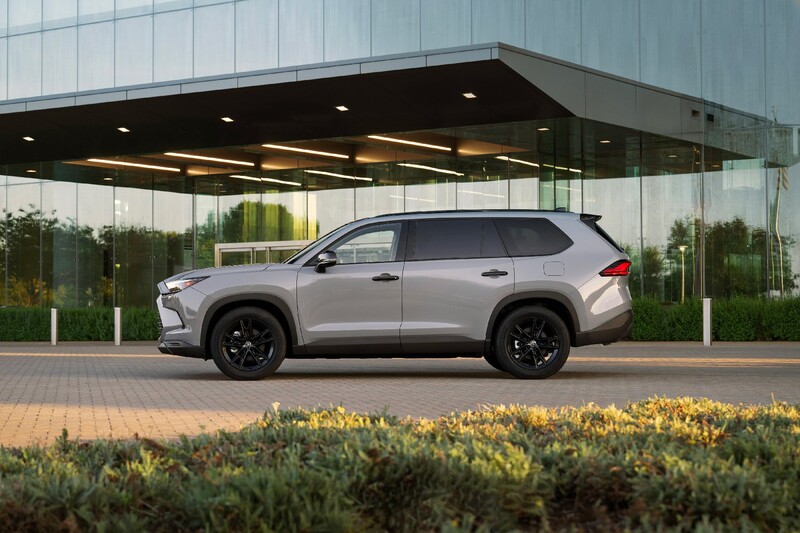
The Grand Highlander is basically a slightly larger Highlander with three rather than just two rows. Both share a common underlying and — for now — drivetrain. Next year, the two-row Highlander will only be available with an electric drivetrain, which some buyers may like, while others may not.
Interestingly, the Grand Highlander — which, remember, is a little larger than the regular Highlander and has a standard third row — comes standard with a lower base price than the regular (two-row) Highlander.
The base Grand Highlander LE stickers for $43,155 — while the regular Highlander starts at $45,570 because the base trim for the two-row Highlander is the XLE, which is the next-up trim available in the Grand Highlander line.
This means the base-trim (XLE) two-row Highlander comes standard with upgrades such as synthetic leather seat covers, heated front seats, a wireless charging pad and a digital (smartphone) key system while the base LE trim Grand Highlander does not come standard with these items. But you may prefer not to pay extra for them.
You have that option with the Grand Highlander. With the two-row Highlander, you don't.
If you do want those extra, you can buy the Grand Highlander XLE, which lists for $45,925.
The Grand Highlander is also available in two other trims: the $50,655 Limited and the top-of-the-line $56,340 Platinum. Limited trims get real leather seat covers, an 11-speaker JBL premium audio system, heated second-row seats, a full-LCD main gauge, secondary infotainment cluster and 20-inch wheels, among other upgrades.
The Platinum adds a panorama glass sunroof, heads-up display, ventilated second-row seats and a self-driving system called Traffic Jam Assistant.
If you're wanting something with a battery — but without the hassles of just a battery — Toyota also offers a hybrid version of the Grand Highlander that offers a significant fuel economy uptick — 36 mpg city, 32 mpg highway versus 21 mpg city, 28 mpg highway for the nonhybrid version.
This one starts at $45,010 for the LE trim, which is about a $2,000 bump up in price versus the nonhybrid LE — but a small enough bump that you'll probably save that much in fuel costs over the vehicle's lifetime.
You can also get a MAX iteration with a much more powerful hybrid drivetrain, but it's limited to the ... Limited ($55,490) and top-of-the-line Platinum ($59,575) trims.
What's New for 2026
This model year is a carryover year, with no significant changes versus last year.
What's Good
— Still comes standard with an engine rather than a battery pack.
— You literally get more for the money versus the two-row Highlander.
— Third row is adult-usable.
What's Not So Good
— A V6 would be more appropriate in a vehicle this size.
— Toyota Safety Sense suite of "assistance" systems is standard — which is kind of like making a wheelchair standard for people who can walk unassisted. (Toyota is not alone in this respect. These "assistance" systems are standard equipment in pretty much every new vehicle.)
— Not as fun to drive — or as appealing to look at — as the Mazda CX-90 (which also comes standard with an inline six).
Under the Hood
Regardless of trim, every Grand Highlander comes standard with the same turbocharged 2.4-liter engine that touts 265 horsepower, paired up with an eight-speed automatic. All trims except the Platinum give you the choice of front-wheel drive or — optionally — all-wheel drive.
The Platinum comes standard with AWD.
Either way, the Grand Highlander can accelerate to 60 mph in about seven seconds, which isn't as quick as the six-cylinder-powered Mazda CX-90, but this probably doesn't matter to people who buy Grand Highlanders to carry the family around.
The hybrid Grand Highlander comes standard with a 2.5-liter four touting 245 horsepower, paired with a continuously variable transmission. The main draw here is the much higher gas mileage, as mentioned earlier. There is also a high-performance MAX iteration that reverts to the 2.4-liter engine and bumps up the output to 362 horsepower, but the mileage drops to 26 mpg city, 27 mpg highway. You also get a six-speed automatic in lieu of the CVT and the same 5,000-pound tow capacity as the nonhybrid models. (The base hybrid with the 2.5-liter four is only rated to tow 3,500 pounds.)
On the Road
Most of the complaints about the Highlander's small four-cylinder engine center on how it sounds — and responds — when you floor the accelerator pedal. Because it does not sound — or respond — like the 3.5-liter V6 did.
This isn't all bad, either.
The retired V6 felt strong as it revved up, which made it enjoyable to rev it up. The turbo four does not sound good when it revs — but it's less necessary to make it rev, because the smaller engine's power curve doesn't require it to get the Highlander moving. With the old V6, you got 295 horsepower — but not until the engine hit 6,600 RPM. The little four's horsepower peak arrives at 6,000 RPM — but it's the torque that makes all the difference. The old V6 made 263 foot-pounds at 4,700 RPM — two thirds of the way to redline. The little four makes 310 foot-pounds — nearly 50 foot-pounds more — and at just 1,700 RPM, which is basically a fast idle.
Put another way, the little four's 310 foot-pounds of torque — which is the better measure of the force that gets a vehicle moving — is available pretty much whenever the engine is running, without need to rev it much. It is thus an easier-going engine, or so it feels like it is — unless you insist on flooring it, at which point it begins to feel (and sound) strained. Toyota figures the typical Highlander buyer isn't the type who likes to floor the accelerator but is the type that likes a vehicle that feels strong without having to floor it — and that's what you're getting here.
Toyota also knows this is a family car, so the handling isn't tuned to be "sporty." It is tuned to be soft and quiet and thus pleasant for the family to ride in for hours at a time.
The hybrid's regenerative braking feature can be used to slow the vehicle without resorting to the brakes, which can extend the life of the pads. You can also drive this one about 600 miles in between fill-ups.
At the Curb
The Grand Highlander is 201.4 inches long — 6.5 inches longer than the regular Highlander. That extra 6 inches allows for a third row and seating for seven to eight people, depending on the configuration. XLE and Limited trims come standard with second-row captain's chairs but can be ordered with a three-across bench, resulting in seven-passenger capacity. The Platinum comes only with the second-row captain's chairs, which means if you want the extras that come with this trim, you'll have to accept the reduced seating capacity.
Regardless, the big draw here is not just the standard third row, as many other crossovers (including the Mazda CX-90) also offer this feature. What makes the Highlander's third row stand out is that it's not just for kids and limber teenagers. Six-foot-tall adults can sit back there comfortably.
There is also the additional room for cargo — even with the third row in use. The Grand Highlander has 20.6 cubic feet behind its third row versus 16 cubic feet for the regular Highlander and a total of 97.5 cubic feet (with the second and third row folded) versus 84.3 cubic feet for the two-row Highlander.
The Rest
The Grand Highlander is also available with a hybrid powertrain, as mentioned — and a plug-in hybrid powertrain — but the good news (for those who prefer not to pay thousands extra for either) is, they're both options. Next year, the regular Highlander will offer no such options. It will be electric only, and that is likely to increase sales of the Grand Highlander, which will be even less expensive and won't cost the buyer time/hassle — as every EV does.
The Bottom Line
The Grand Highlander isn't exactly exciting.
But it's exciting that it isn't "electrified." It also gets the job done better than most, which has the kind of long-term appeal that less practical alternatives lack, once the excitement wanes.
Eric's latest book, "Doomed: Good Cars Gone Wrong!" will be available soon. To find out more about Eric and read his past columns, please visit the Creators Syndicate webpage at www.creators.com.
View the Toyota Grand Highlander this week.







View Comments